Compare magnet-feeding proposals with actual supplied clusters or stacks, orientation/polarity requirements, permitted contact, receiving tooling and accepted handoff/recovery results.
In brief
Compare controlled stack or tray presentation with bulk feeding using the same magnet revision and supplied magnetic state. Include realistic clusters, orientation/polarity requirements, permitted contact and damage limits, and the actual gripper or nest. Count usable singles at the downstream handoff with interventions and recovery included.
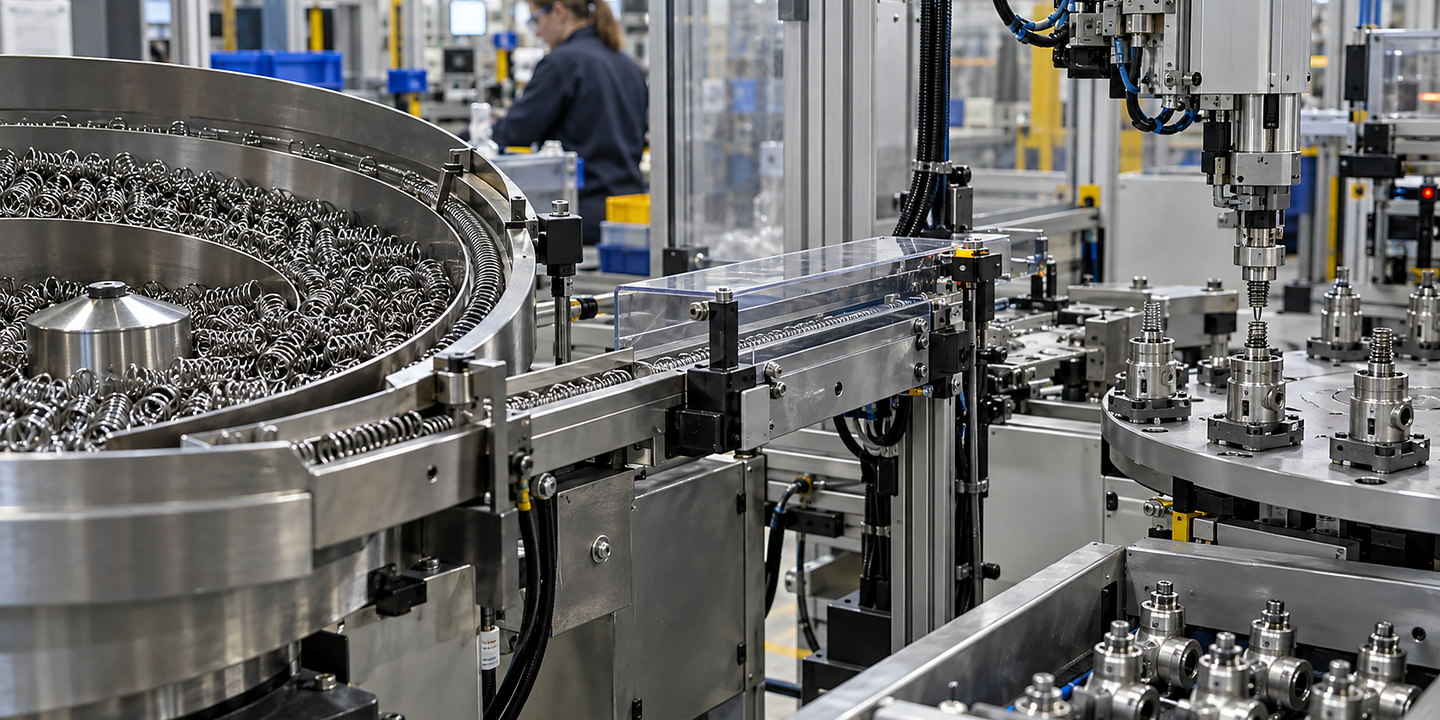
Prepare the same incoming-part and contact information and agree the same acceptance checks. Generic component-feeding photographs do not establish magnetic-part separation, polarity verification or a particular customer installation. Each proposed route still needs representative trials in the intended tooling environment.
On the production floor
See how the complete system fits your production line — Magnet Feeding Systems
Plan magnet feeding systems around real component variation, bulk condition, orientation, usable delivery rate and the downstream interface. Discuss representative part trials with Sorting Solutions. When you compare solutions, check how each option handles component geometry and variation for magnetic-component separation & feeding, surface, fragility and entanglement behaviour and your surrounding line.
Magnet Feeding Systems support from first review to production use
Understand your requirement
Provide production magnets with revision, geometry, supplied magnetic condition and normal packaging. Identify clusters/stacks/trays, permitted contact surfaces, cosmetic/edge requirements and the final face or polarity condition needed by the next operation.
Compare suitable approaches
Compare controlled stack/tray and bulk routes against the real starting condition. Record singulation, recirculation, multiple parts, damage and interventions through normal cluster and bulk-level variation, including any separate polarity decision required.
Fit the complete line
Show the actual receiving gripper or nest, nearby metal components, gap and orientation. Prove pickup and release, and agree how uncertain or multiple parts are contained, the next advance is controlled and recovery returns to a known state.
Prove and support the result
Retain accepted singles at handoff, wrong presentations, required polarity decisions, damage examples and interventions. Include refill, part changes and difficult normal clusters, with the receiving-tool arrangement and unresolved limitations recorded.
Typical support: sample assessment, feeding trials, orientation tooling, controls, escapement and line integration.
Compare your options
Compare magnet feeding systems with simpler routes
Approach
Often suitable when
Watch for
Magnet Feeding Systems
You need a dedicated solution for a clearly defined duty, product or part range and line interface.
Sample trials must include normal, marginal and supplier-variant components.
Flexible Vision-Guided Feeding for Suitable Variable Part Families
Your volumes, product mix or operator judgement make a simpler route more practical.
Check ergonomics, consistency and safe access before choosing the lower-complexity option.
Manual or Tray Presentation where Bulk Feeding Would Damage Parts or Add Unjustified Complexity
Your surrounding process is stable enough for a broader automated solution to add value.
Allow for line connections, fault recovery and maintenance as well as the headline equipment.
What to send us
Help us give you useful guidance
Representative Production ComponentsInclude the current revision and explain what this information should show for your operation.
Usable Delivery-Rate and Recovery ObservationsInclude the current revision and explain what this information should show for your operation.
Damage, Jam and Replenishment TestsInclude the current revision and explain what this information should show for your operation.